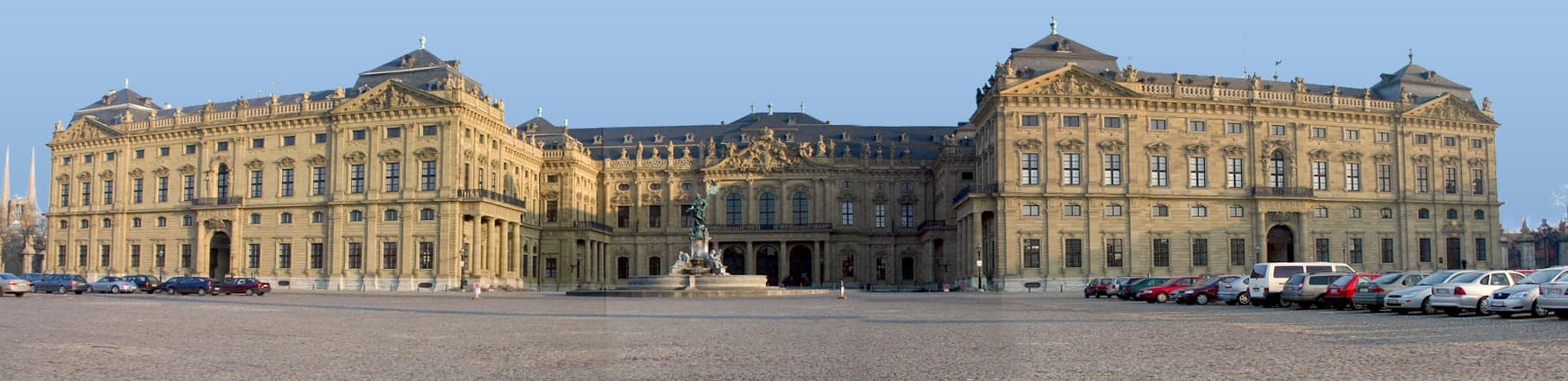
cultural heritage monument D-6-63-000-454 (0) in Würzburg, Bavaria
The Würzburg Residence (German: Würzburger Residenz) is a palace in Würzburg, Germany. Johann Lukas von Hildebrandt and Maximilian von Welsch, representatives of the Austrian/Southern German Baroque style, were involved in the construction, as well as Robert de Cotte and Germain Boffrand, who were followers of the French style. Balthasar Neumann, court architect of the Bishop of Würzburg, was the principal architect of the Residence, which was commissioned by the Prince-Bishop of Würzburg Johann Philipp Franz von Schönborn and his brother Friedrich Carl von Schönborn in 1720, and completed in 1744. The Venetian painter Giovanni Battista Tiepolo, assisted by his son, Domenico, painted frescoes in the building. Interiors considered masterworks of Baroque/Rococo or Neoclassical architecture and art include the grand staircase, the chapel, and the Imperial Hall. The building was reportedly called the "largest parsonage in Europe" by Napoleon. It was heavily damaged by British bombing during World War II, and restoration has been in progress since 1945. Since 1981, the Residence has been a UNESCO World Heritage Site in recognition of its outstanding Baroque art, design, and architecture.
Würzburg Residence is located in Würzburg, Germany. Its specific geographic coordinates are latitude 49.7928 and longitude 9.9389.
The museum was established in 1719, making it a significant historical institution in the region.
Yes, it is quite popular, attracting approximately 350,000 visitors annually.
cultural heritage monument D-6-63-000-454 (0) in Würzburg, Bavaria... It is a key destination for those interested in culture and history in Germany.