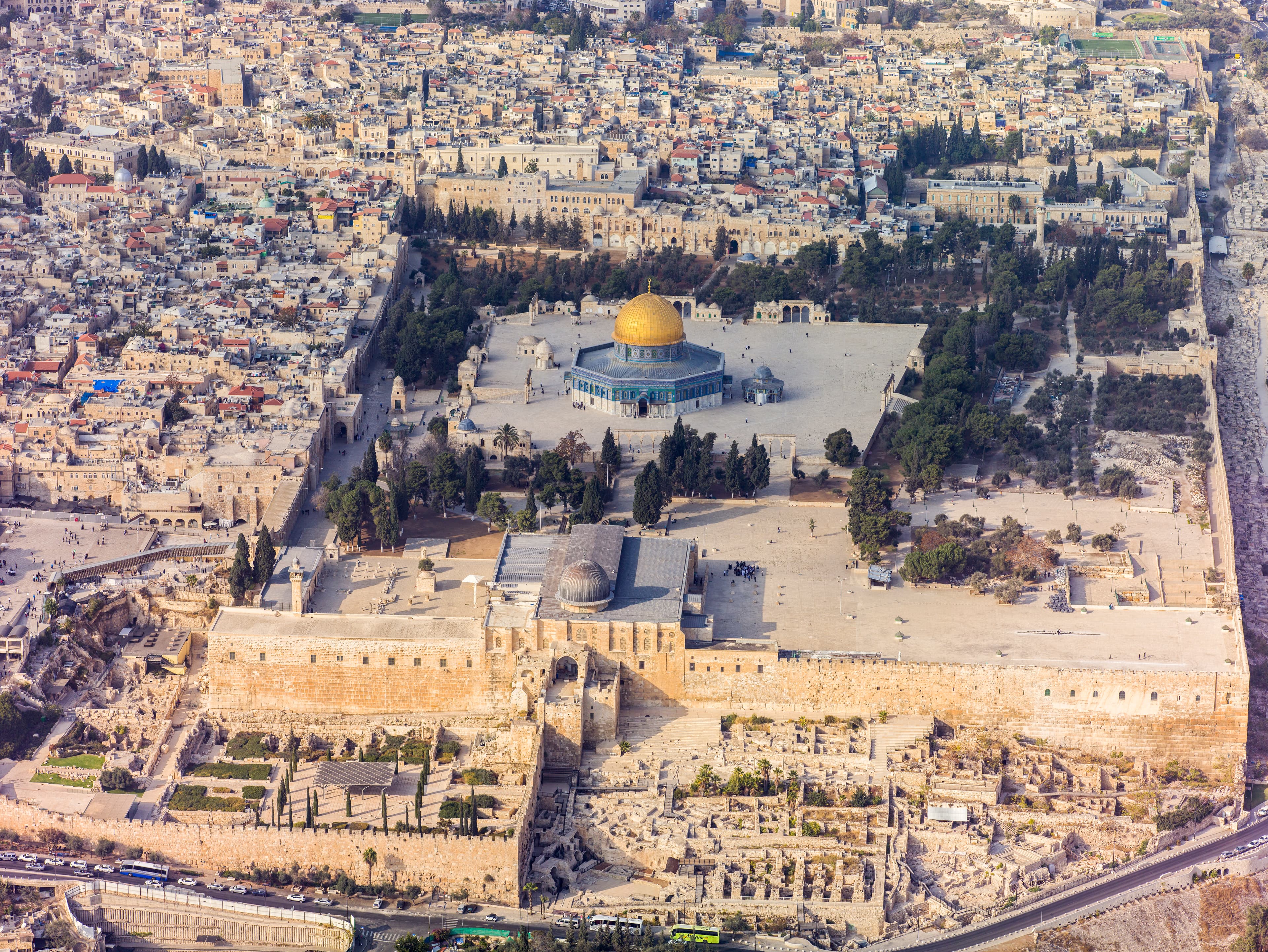
The Temple Mount (Biblical Hebrew: הַר הַבַּיִת, romanized: Har hab-Bayiṯ, (Arabic: الأَقْصَى, romanized: al-Aqṣā)) is a hill in the Old City of Jerusalem. Once the site of two successive Temples in Jerusalem, it is now home to the Islamic compound known as al-Aqsa, which includes the al-Aqsa Mosque and the Dome of the Rock. It has been venerated as a holy site for thousands of years, including in Judaism, Christianity and Islam. The present site is a flat plaza surrounded by retaining walls (including the Western Wall), which were originally built by Herod the Great in the first century BCE to expand the Second Temple. The plaza is dominated by two monumental structures originally built during the Rashidun and early Umayyad caliphates after the 637 first Muslim conquest of Jerusalem: the Qibli Mosque of al-Aqsa and the Dome of the Rock, near the center of the hill, which was completed in 692, making it one of the oldest extant Muslim structures in the world. The Herodian walls and gates, with additions from the late Byzantine, early Muslim, Mamluk, and Ottoman periods, flank the site, which can be reached through eleven gates, ten reserved for Muslims and one for non-Muslims, with guard posts of the Israel Police in the vicinity of each. The courtyard is surrounded on the north and west by two Mamluk-era porticos or arcades (arwiqa) and four minarets. The Temple Mount is the holiest site in Judaism, and where the Temples in Jerusalem once stood. According to Jewish and Samaritan tradition and scriptures, the first Temple was Solomon's Temple, built by King Solomon, the son of King David, in 957 BCE, and was destroyed along with the city itself by the Neo-Babylonian Empire in the Siege of Jerusalem (587 BC), in 587 BCE. No archaeological evidence has been found to verify the existence of the First Temple, and scientific excavations are limited due to religious sensitivities. The Second Temple, constructed under Zerubbabel in 516 BCE, was later renovated by King Herod and destroyed by the Roman Empire in 70 CE. Orthodox Judaism maintains it is here that the third and final Temple will be built when the Messiah comes. Jews face the Temple Mount during prayer. Jewish attitudes towards entering the site vary. Due to its extreme sanctity, many Jews will not walk on the Mount itself to avoid unintentionally entering the area where the Holy of Holies stood, since, according to rabbinical law, there is still some aspect of the divine presence at the site. The Al-Aqsa mosque compound atop the site is the second oldest mosque in Islam, and one of the three Sacred Mosques, the holiest sites in Islam; it is revered as "the Noble Sanctuary". Its courtyard (sahn) can host more than 400,000 worshippers, making it one of the largest mosques in the world. For Sunni and Shia Muslims alike, it ranks as the third holiest site in Islam. The plaza includes the location regarded as where Muhammad ascended bodily into heaven, and served as the initial qibla, the direction Muslims turn towards when praying. As in Judaism, Muslims also associate the site with Solomon and other prophets also venerated in Islam. The site, and the term "al-Aqsa", in relation to the whole plaza, is also a central identity symbol for Palestinians, including Palestinian Christians. Since the Crusades, the Muslim community of Jerusalem has managed the site through the Jerusalem Waqf. The site, along with the whole of East Jerusalem (which includes the Old City), was controlled by Jordan from 1948 until 1967 and has been occupied by Israel since the Six-Day War of 1967. Shortly after capturing the site, Israel handed its administration back to the Waqf under the Hashemite (Jordanian) custodianship while maintaining Israeli security control. Israel enforces a ban on prayer by non-Muslims as part of an arrangement usually referred to as the "status quo". The site remains a major focal point of the Israeli–Palestinian conflict.