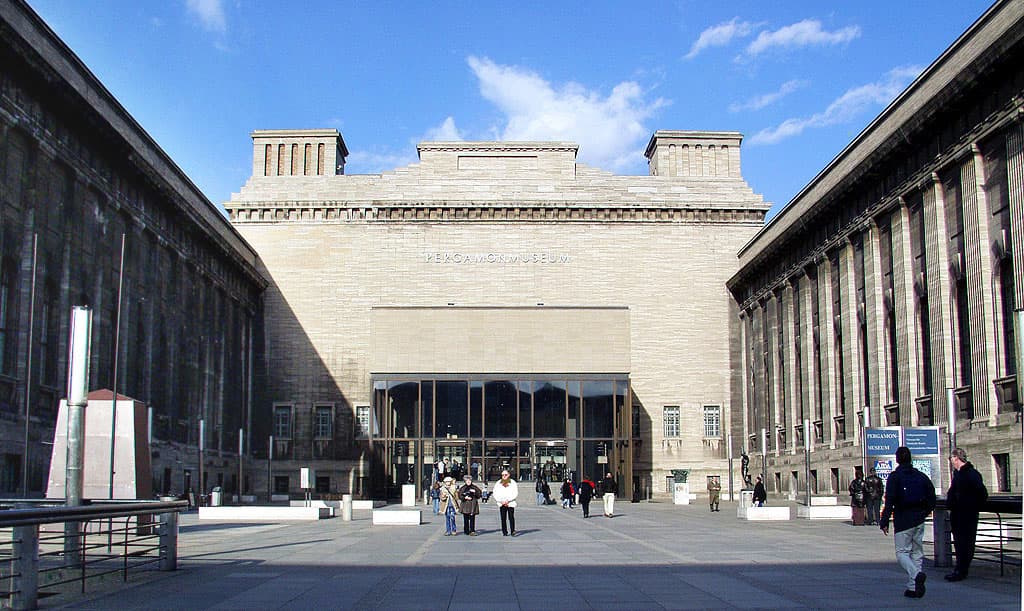
museum building in Berlin, part of the Museumsinsel, presents the Vorderasiatisches Museum, the Museum für Islamische Kunst and parts of the Antikensammlung
The Pergamon Museum (German: Pergamonmuseum; pronounced [ˈpɛʁ.ɡa.mɔn.muˌzeː.ʊm] ) is a listed building on the Museum Island in the historic centre of Berlin, Germany. It was built from 1910 to 1930 by order of Emperor Wilhelm II and according to plans by Alfred Messel and Ludwig Hoffmann in Stripped Classicism style. As part of the Museum Island complex, the Pergamon Museum was added to the UNESCO World Heritage List in 1999 because of its architecture and testimony to the evolution of museums as architectural and social phenomena. Prior to its closing in 2023, the Pergamon Museum was home to the Antikensammlung, including the famous Pergamon Altar, the Vorderasiatisches Museum and the Museum für Islamische Kunst. In October 2023, the museum was completely closed for visitors, and is expected to remain mostly closed for 14 to 20 years – until 2037 to 2043 – for the execution of comprehensive renovation works. Its North Wing is expected to reopen in 2027.
Pergamon Museum is located in Bezirk Mitte, Germany. Its specific geographic coordinates are latitude 52.5210 and longitude 13.3960.
The museum was established in 1910, making it a significant historical institution in the region.
Yes, it is quite popular, attracting approximately 739,000 visitors annually.
museum building in Berlin, part of the Museumsinsel, presents the Vorderasiatisches Museum, the Museum für Islamische Kunst and parts of the Antikensammlung... It is a key destination for those interested in culture and history in Germany.