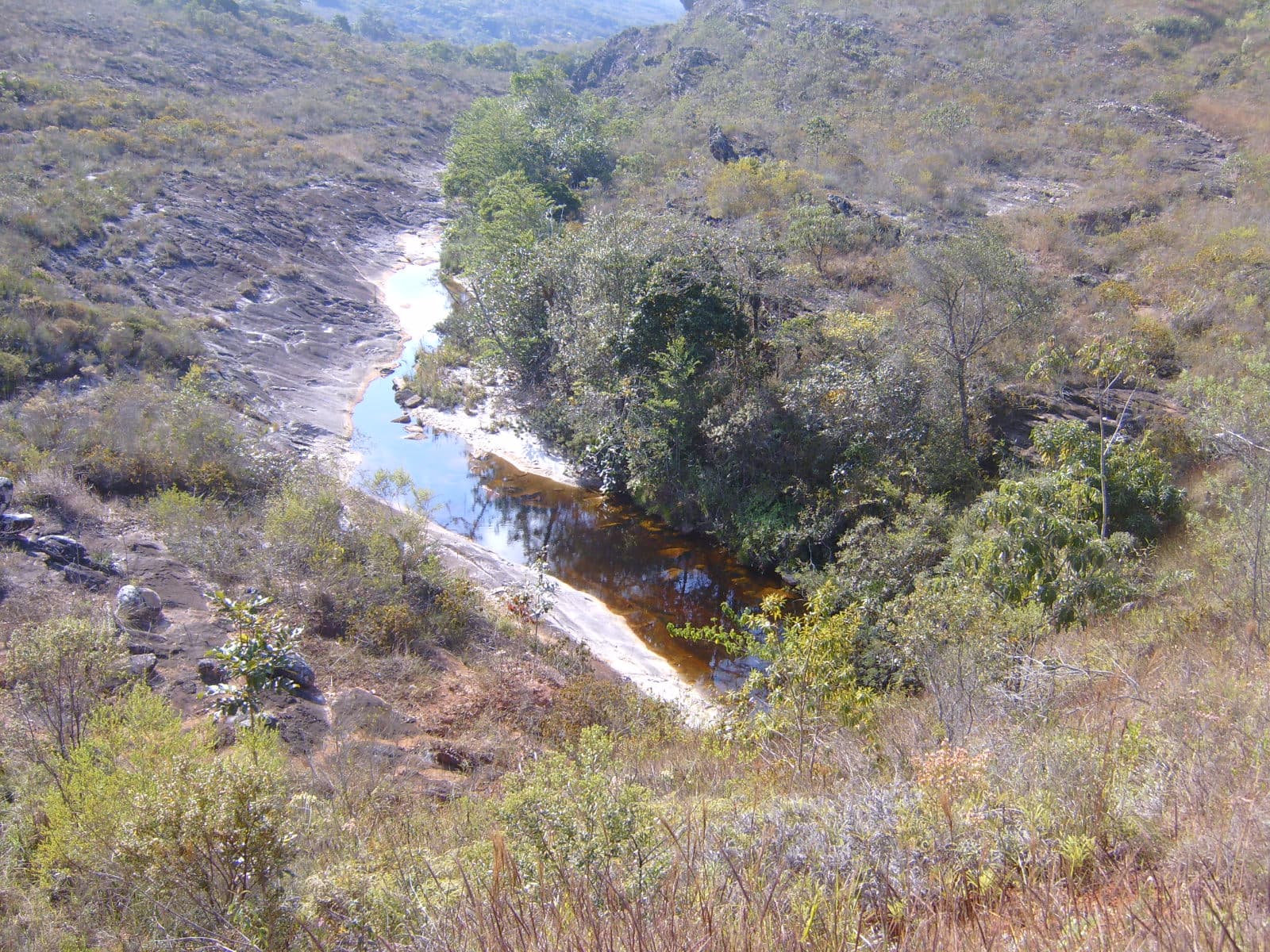
The Jequitinhonha River (Brazilian Portuguese pronunciation: [ʒekitʃiˈɲõɲɐ]) flows mainly through the Brazilian state of Minas Gerais. Its source lies near Diamantina in the Espinhaço Mountains at an elevation of 1,200 metres (3,900 ft), after which it flows northward and then east-northeastward across the uplands. At Salto da Divisa, it is interrupted by the Cachoeira (falls) do Salto Grande, 43 metres (141 ft) high. The river descends to the coastal plain at the city of Jequitinhonha, and empties into the Atlantic Ocean at Belmonte in Bahia state after a course of approximately 1,090 kilometres (680 mi). The main tributaries are the Araçuaí, Piauí, São Miguel, Itacambiruçu, Salinas, São Pedro, and São Francisco. The electrical company of Minas Gerais (CEMIG) constructed a hydroelectric plant on the river between Berilo and Grão Mogol. The Usina Presidente Juscelino Kubitschek, the hydroelectric plant powered by Irapé Dam, has an installed capacity of 360 MW and regulates the waters of the river which periodically flood. CEMIG began the work in 2002 and in April 2003 diverted the river to two tunnels with a length of more than 1.2 km (three-quarters of a mile). The dam and power station were completed in 2006.

