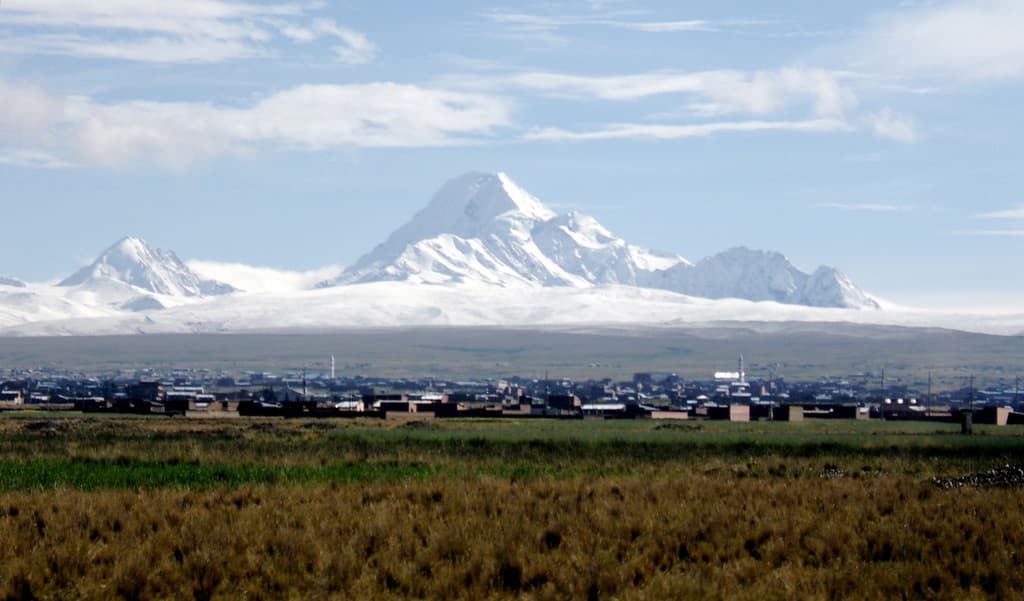
Huayna Potosí is a fold mountain located in western Bolivia, near the city of El Alto and approximately 25 km (16 mi) north of La Paz, the country's administrative capital. It rises to an elevation of 6,088 m (19,974 ft) above sea level and forms part of the Cordillera Real range of the larger Andes, which runs parallel between the intermountain plains of the Altiplano and the lowland forests of the Yungas region leading to the Amazon basin. Surrounded by high mountains, it is roughly 15 miles due north of the city, which makes this mountain the most popular climb in Bolivia. The normal ascent route is a fairly straightforward glacier climb, with some crevasses and a steep climb to the summit. However, the other side of the mountain—Huayna Potosí West Face—is the biggest face in Bolivia. Several difficult snow and ice routes ascend this 1,000-meter-high face. The first ascent of the normal route was undertaken in 1919 by Germans Rudolf Dienst and Adolf Schulze. Some climbing books report this mountain as the "easiest 6,000er in the world", but this claim is debatable. The easiest route entails an exposed ridge and sections of moderately steep ice, with a UIAA rating of PD. There are many 6,000 m mountains that are easier to climb in terms of technical difficulty. Perhaps therefore, the main reason Huayna Potosí has been referred to as the easiest 6,000 m climb is that the elevation gain from trailhead to summit is less than 1,400 m; with easy access from La Paz. Since La Paz is at 3,640 m, climbers have an easier time acclimatizing.

