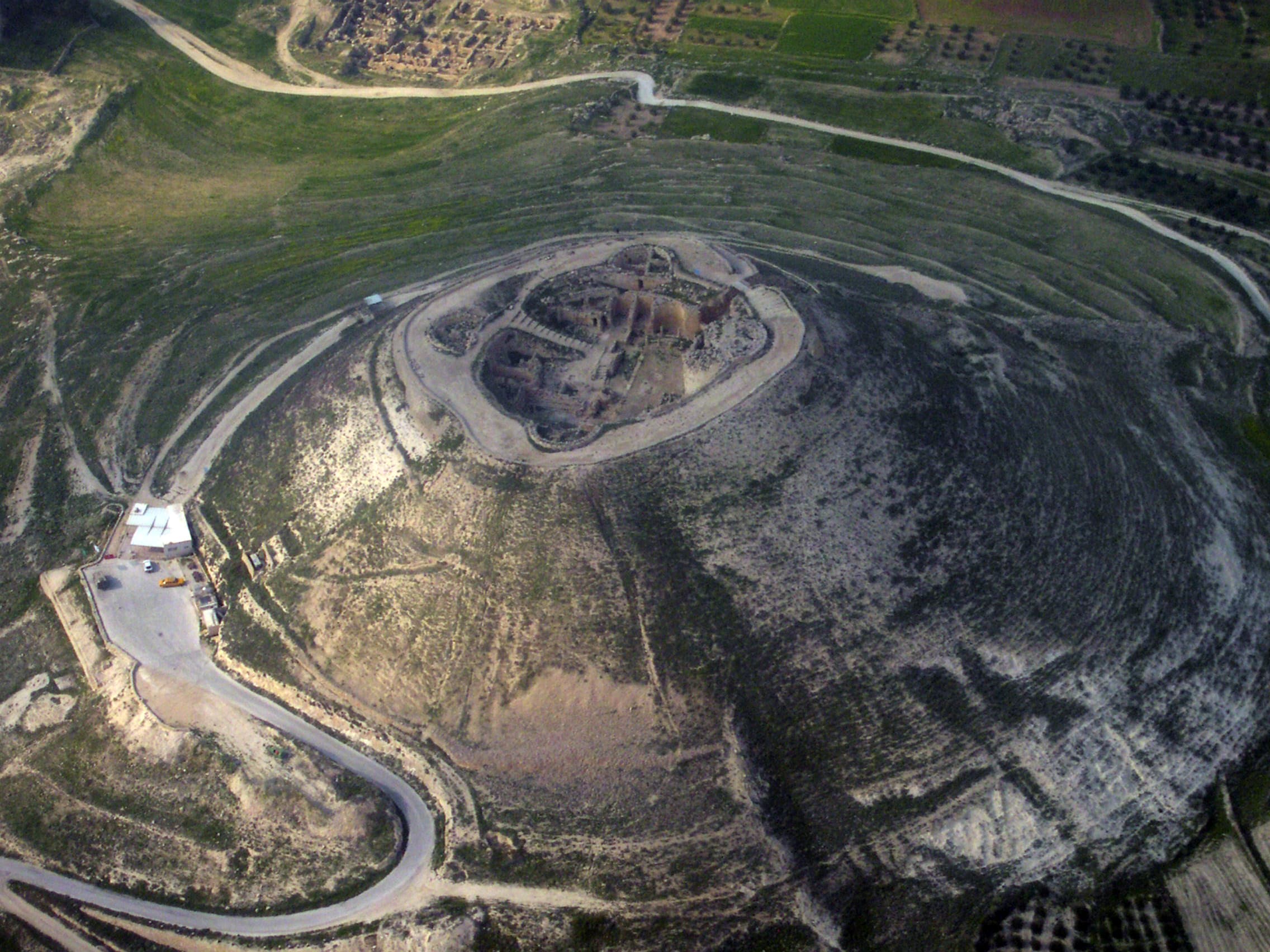
The Herodeion (Ancient Greek: Ἡρώδειον), in Latin: Herodium, in Modern Hebrew: הרודיון Herodion, known in Arabic as Jabal al-Fureidis (Arabic: جبل فريديس, lit. '"Mountain of the Little Paradise"') is a fortified desert palace built by Herod the Great, king of Judaea, in the first century BCE. The complex stands atop a hill in the Judaean Desert, approximately 12 kilometres (7.5 mi) south of Jerusalem and 5 kilometres (3.1 mi) southeast of Bethlehem, between Beit Ta'mir, Za'atara to the east and Jannatah, Tekoa and Nokdim to the west. The site is located at an elevation of 758 meters (2,487 ft) above sea level. Herodium was originally built by Herod to commemorate his victory in 40 BCE over the Hasmonean ruler Antigonus II Mattathias during their struggle for control of Judaea. The site stands atop an artificial, cone-shaped hill that dominates the surrounding landscape and can be seen from Jerusalem. At its summit, Herod's engineers built a fortified palace with double walls, towers, a Roman-style bathhouse, banquet halls, and residential quarters. At the base, a lower palace complex was built complete with gardens, courtyards, and a large pool fed by aqueducts. According to the historian Josephus, Herod was buried at the site following his death in 4 BCE. Herodium remained active during the Jewish–Roman wars. Jewish rebels occupied the site during the First Jewish–Roman War (66–73 CE), repurposing the dining hall into a synagogue before it was captured by the Romans in 71 CE. The fort was again used as a rebel base during the Bar Kokhba revolt (132–135 CE), after which it was abandoned. From 1972 onward, intermittent excavations were carried out by Prof. Ehud Netzer, working on behalf of the Hebrew University of Jerusalem. In 2007, he found and identified the long sought-after tomb of King Herod on the northern slope of the hill. Netzer excavated mostly the lower palace, at the base of the hill; he fell to his death at the site in 2010. The site is in Area C of the West Bank, formally under the jurisdiction of the Israeli Civil Administration, a body of military officers, and in practice it is administered jointly with the Israel Nature and Parks Authority. Israel asserts that it is entitled to work in the area under the Oslo Accords, but the Palestinian authorities say Israel has no right to undertake digs there or remove artifacts that Israel discovered in excavations there.

